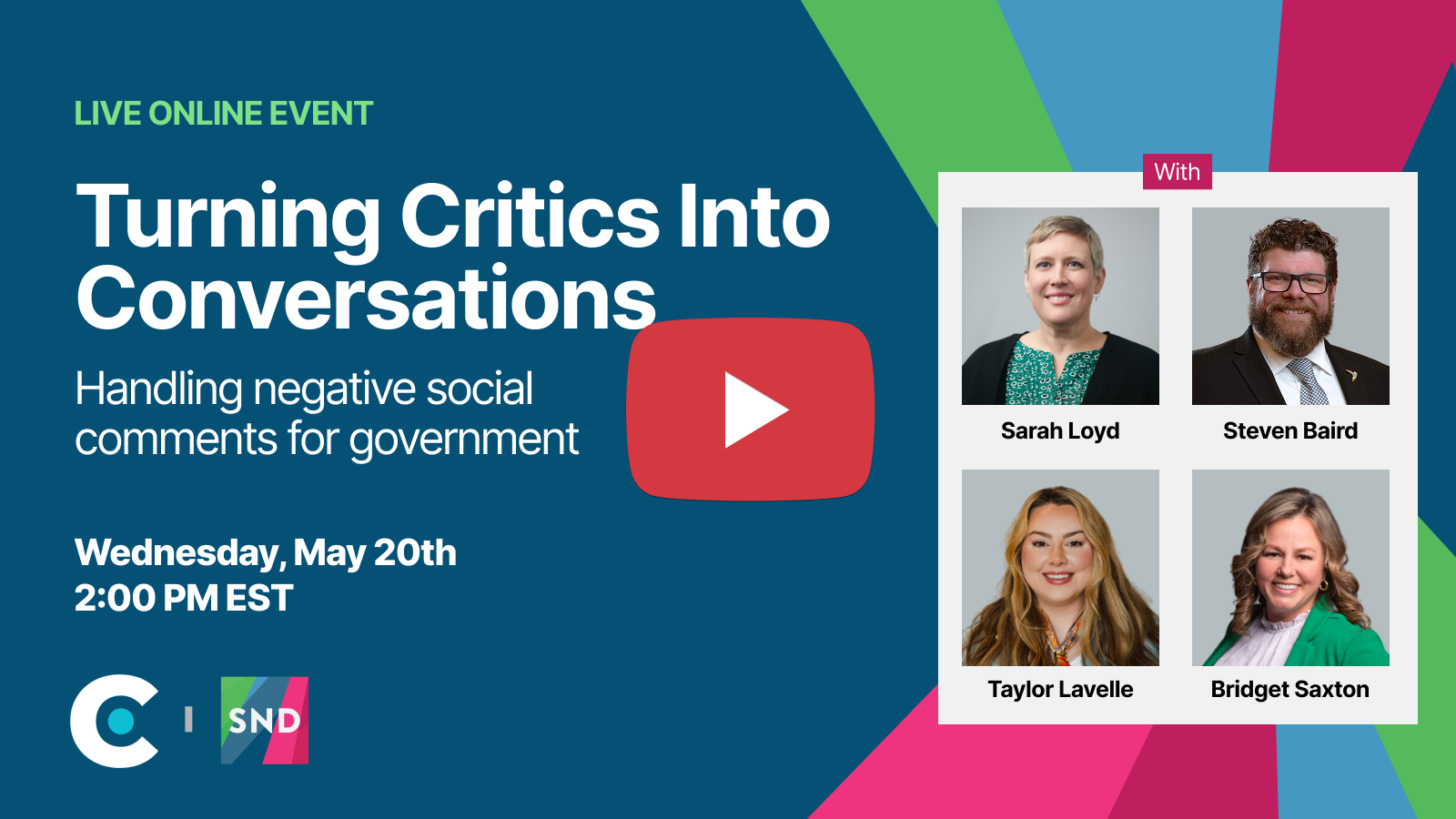
In this Social News Desk/CivAll webinar, Sarah Loyd, Head of Product Success & Evangelism at Social News Desk, sits down with a panel of public sector experts to discuss how to successfully navigate the tricky waters of negative social comments:
Steven Baird, Public Affairs Associate II at Las Virgenes Municipal Water District
Taylor Lavelle, Digital Communication Manager for the City of Melissa, Texas
Bridget Saxton, Communications Director / PIO for the City of Melissa, Texas
Know What You’re Dealing With
Before you type out a hasty response, you need to identify the nature of the comment. Sarah outlines a four-part framework to categorize the negativity coming your way:
Genuine Complaint: A resident who had a poor experience or has a real concern. They are acting in good faith and ultimately want to be heard.
Misinformation: False information spreading in your comments. Ignoring this can be dangerous, as silence can often look like confirmation.
Frustrated Venting: An emotionally driven comment that isn’t always personal. The user likely just had a bad day, and your post happened to be in front of them.
Bad Faith / Coordinated Attack: Trolls, bots, or organized pylon campaigns. These users are not operating in good faith and likely never will.
The 3-Question Test
Before making a move, slow down and run the comment through three quick diagnostic questions:
Is it factual? Factual errors often require correction, whereas standard negative opinions don’t always need a reply.
Is it in good faith? Good faith deserves a human response; bad faith generally doesn’t.
Does it need a public response? Will the broader community benefit from seeing your answer?
Decide Your Move Before You Type
Once you’ve diagnosed the comment, you can decide on the appropriate reaction matrix:
Respond Publicly: If it’s factual, in good faith, and benefits the community, acknowledge the concern briefly and humanly.
Move to DMs: If a conversation is genuine but gets too detailed, or requires personal account information, steer them toward a private message.
No Response: Don’t swing at every pitch. For standard trolls, sometimes silence is your best strategic option.
Hide or Remove: If a comment crosses the line into profanity, spam, or a clear violation of your guidelines, hide or remove it.
Real-World Insights From Our Panelists
On what negative comments actually look like
Steven notes that as a water provider, most negative comments strike at their core mission, such as residents questioning water safety because of discoloration.
He also encounters regular public agency cynicism, like accusations of “stealing water” or “getting rich off residents.” Meanwhile, Taylor and Bridget face “growing pains” comments in Melissa, Texas, one of the fastest-growing cities in the country, where residents frequently complain about construction, traffic, and infrastructure changes.
On moments that test your skin
Taylor shares a scenario involving a major water line break caused by a contractor. Information was shifting by the minute, and the public quickly began pointing fingers.
Taylor explains that while the situation was high-stress, it underscored that “people just don’t know what they don’t know.” Steven shares a highly unusual event where a staff spotlight post for Women’s History Month attracted an estranged, highly toxic family member of the employee in the comment section.
Steven handled the boundary-crossing behavior by utilizing Facebook’s reporting mechanisms to let the platform safely remove the inflammatory content.
On utilizing the right tools
When comments get heated, Taylor highlights a surprising ally: ChatGPT. If she is feeling emotionally charged by a persistent commenter, she will draft a response and ask the AI to “make this a little friendlier” to strip the human bias and emotion out of the final reply.
The Ultimate Shield: Get a Comment Policy in Place
The consensus among the entire panel is clear: your absolute best line of defense is a formal, published comment policy. Bridget and Taylor reveal that crafting the social media policy for the City of Melissa was a thorough seven-month process involving their legal team.
Steven emphasizes that a structured policy protects your staff from making stressful judgment calls on the fly. He also shares his ironclad baseline rule for moderation: Never delete or hide anything without archiving it first and securing a “permission slip” from legal.
Protect Your Agency with SND Archive
When comments are edited or deleted, whether by a platform, a user, or your team, the original text vanishes. If you don’t have a record of what a comment said and exactly why it violated your policy, your agency faces real compliance risks during public records requests.
SND Archive automatically runs in the background, capturing a complete, searchable history of your social media interactions (including edited and deleted content) so your team is always legally protected.