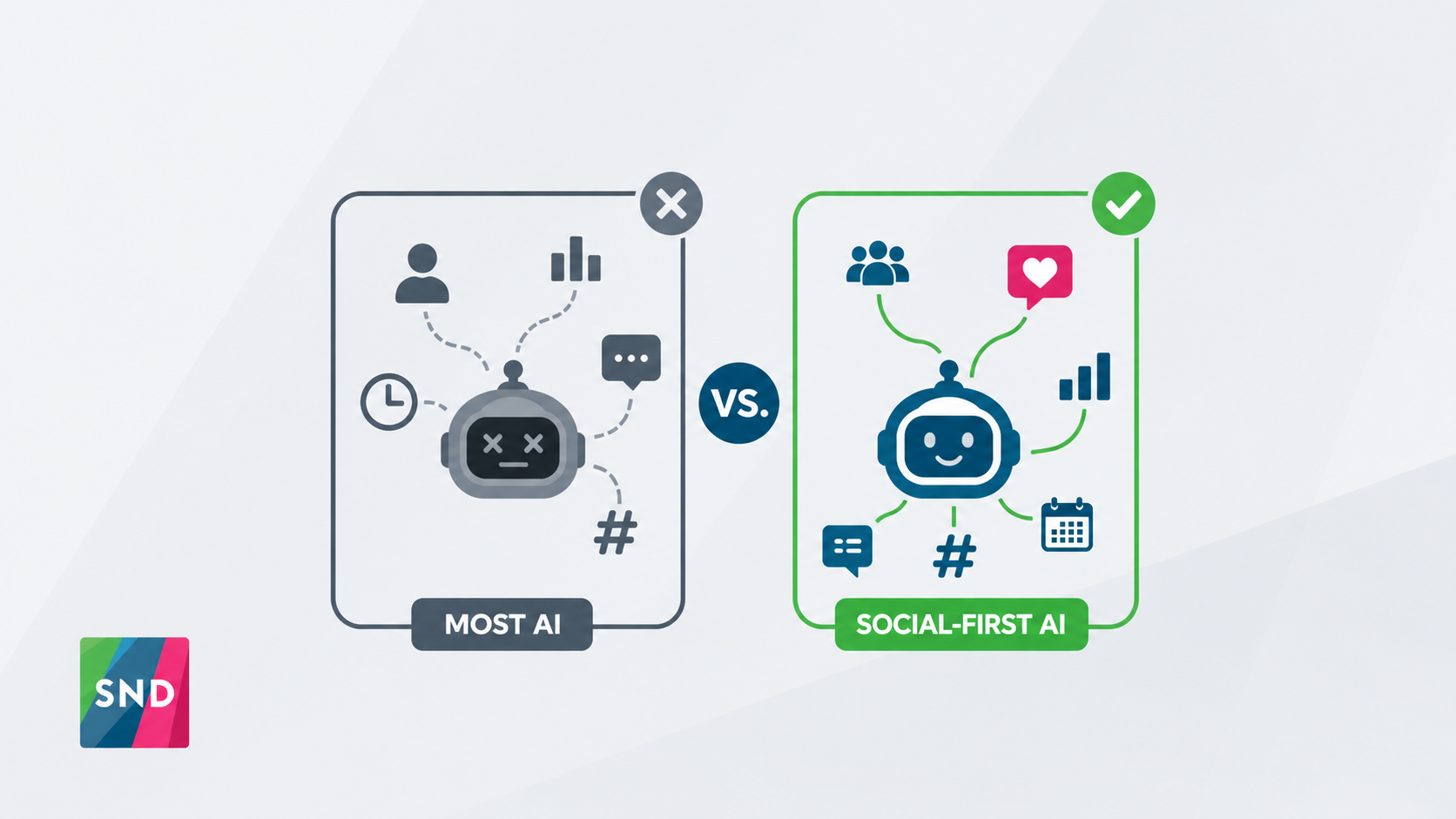
AI isn’t failing social teams because it lacks capability. It’s failing because it’s built for the wrong problem.Most AI tools are designed to generate content at scale. But social media isn’t a scale problem—it’s a relevance problem. Success in social depends on timing, context, and platform nuance, all of which shift constantly and often unpredictably.
This disconnect creates what can be defined as the Social Relevance Gap: the difference between content that can be produced quickly and content that actually performs in real time.
As AI adoption accelerates across marketing, many organizations are discovering that efficiency gains don’t automatically translate to better outcomes in social. In fact, without the ability to interpret live conversations, adapt to platform dynamics, and align with audience expectations, AI can introduce more friction than it removes.
For social teams, the question is no longer whether to use AI. It’s whether their AI is built to operate in an environment where relevance—not volume—is the primary driver of success.
The Speed of Social vs. The Pace of AI
Social media operates on a continuous, real-time feedback loop. Trends emerge, evolve, and disappear within hours. Audience sentiment can shift just as quickly. Most AI systems aren’t designed for that environment. They rely on broad training data and generalized patterns, which means they often lag behind the conversations that matter most.
Research from Pew Research Center highlights how quickly information flows across platforms. In its Social Media and News Fact Sheet, Pew notes that a significant portion of U.S. adults regularly get news from social media—reinforcing that these platforms function as real-time information ecosystems.
This creates a fundamental mismatch: AI can generate content quickly, but it can’t always generate content that’s current. What this means for social teams: Speed without timeliness isn’t useful. If AI can’t keep up with live conversations, it can’t help teams participate in them effectively.
The Hidden Cost of “Efficient” Content
At a glance, AI appears to make content creation faster. But in practice, many social teams find themselves spending significant time refining outputs. Why? Because generic AI lacks:
-
Brand voice precision
-
Platform-specific tone
-
Awareness of current trends
Insights from McKinsey & Company reinforce this challenge. In its report on the economic potential of generative AI, McKinsey notes that productivity gains depend heavily on how well AI is applied to specific workflows—especially those requiring nuance and judgment.
In social, that nuance is everything. Instead of eliminating work, AI often redistributes it—from creation to correction. If AI outputs require constant rewriting, they’re not saving time—they’re shifting where time is spent.
Why Context is the Real Competitive Advantage
The defining factor in social performance isn’t content volume—it’s contextual accuracy.High-performing teams don’t just publish frequently—they make strategic decisions about when and how to engage. This is especially true on platforms like TikTok and Instagram, where trends are shaped by cultural signals, not just keywords.
Most AI tools aren’t built to evaluate these dynamics. They generate content based on prompts—not on situational awareness. That limitation is where the Social Relevance Gap becomes most visible: content may be technically correct, but strategically irrelevant. Without context, AI can produce content—but it can’t guide decisions. And in social, decisions drive performance.
The Social Relevance Gap in Action
When AI tools aren’t aligned with how social works, the impact shows up quickly. Teams experience:
-
Missed trend windows
-
Lower engagement
-
Slower approval cycles
-
Increased reliance on manual review
From a business perspective, this creates inefficiencies that compound over time. According to Gartner, organizations see the strongest ROI from AI when it’s aligned to clearly defined, high-impact use cases. (See: Top Strategic Technology Trends in AI)
Social is one of those use cases—but only when tools are designed for its unique constraints. Misaligned AI doesn’t just underperform—it slows down both execution and strategic decision-making.
What Defines Social-First AI: A Practical Standard
Closing the Social Relevance Gap requires a different approach—not incremental improvements to existing tools, but a redefinition of what AI should do for social teams. Social-first AI can be evaluated against five core capabilities:
1. Real-time awareness
Surfaces emerging trends and active conversations as they happen—not after they’ve peaked.
2. Platform-specific intelligence
Adapts content based on platform norms, formats, and audience expectations.
3. Contextual decision support
Helps teams determine whether to engage, not just what to say—factoring in timing, relevance, and brand alignment.
4. Native-quality output
Produces content that reflects how real users communicate, minimizing the need for heavy editing.
5. Workflow integration
Fits seamlessly into publishing, planning, and engagement processes without adding friction. For broader context on how AI is reshaping marketing workflows, HubSpot offers a useful overview in its AI marketing resources—though social requires a more specialized, real-time approach.
Together, these capabilities redefine AI as a strategic tool—not just a production engine.
What this means for social teams: The value of AI isn’t measured by output volume. It’s measured by how effectively it supports real-time, high-stakes decisions.
Why This Shift is Happening Now
The expectations placed on social teams are increasing. They’re being asked to:
-
Publish more content
-
Respond faster to trends
-
Prove measurable impact
At the same time, audiences expect content that feels immediate, relevant, and authentic. This combination is forcing a shift in how AI is evaluated. Tools that prioritize scale without relevance are quickly becoming obsolete. Relevance is no longer a competitive advantage—it’s the baseline.
Conclusion: From Automation to Alignment
The next phase of AI in marketing will not be defined by who can generate the most content. It will be defined by who can generate the most relevant content—consistently, and in real time.
For social teams, this requires a fundamental shift in how AI is evaluated. It’s no longer enough for AI to produce outputs quickly or at scale. To deliver real value, it must operate within the constraints that define social performance: immediacy, context, and platform-specific expectations.
This is the standard that will separate useful AI from noise. Teams that recognize this shift early will move faster, engage more effectively, and make better strategic decisions. Those that don’t will continue to spend time correcting, rewriting, and second-guessing outputs that were never designed for social in the first place.
The future of AI in social isn’t about automation alone. It’s about alignment. And going forward, the most important question isn’t whether AI can create content—it’s whether it understands when, where, and why that content should exist at all.